Contract logistics for manufacturing
Nearshore your supply chain six miles from the U.S. border, under IMMEX — one dedicated, accountable cross-border operation. North American lead times in days, not the weeks of offshore manufacturing.
What is contract logistics?
Contract logistics is a long-term, dedicated outsourcing model where a single provider manages a manufacturer's warehousing, cross-border distribution, customs coordination and value-added operations under one integrated agreement. Unlike transactional 3PL, it is built around fixed scope, defined service levels and a multi-year partnership — giving manufacturers predictable cost and a single point of accountability for their North American supply chain.
For a manufacturer scaling into the U.S., it's the difference between juggling vendors and running one accountable, cross-border operation.
Why are manufacturers rethinking cross-border logistics in 2026?
The IMMEX landscape has tightened — Annex 24 inventory rules are stricter, enforcement has escalated and digital-first compliance requirements are coming. For manufacturers, cross-border logistics is no longer only a cost question; it is a compliance-risk question.
Most manufacturers don't have the bandwidth to absorb that risk while running production. That's the gap a contract logistics partner fills: Lateral operates the IMMEX-compliant infrastructure, so your team stays focused on building product — not managing customs exposure.
- 01Annex 24
Stricter inventory control — tighter traceability obligations on IMMEX inventory.
- 02Enforcement
Escalated fiscalization — more audits, less tolerance for documentation gaps.
- 03IMMEX 4.0
Digital-first compliance — reporting moves to a digital-native regime.
How does contract logistics differ from transactional 3PL?
Same warehouse footprint, fundamentally different relationship. Here's what changes when you move from pay-per-use to a dedicated agreement.
| Criterion | Transactional 3PL | Contract Logistics |
|---|---|---|
| Scope | Warehousing & shipping | Warehousing, customs coordination, cross-border, VAS, returns — integrated |
| Cost structure | Variable, fluctuates with volume | Predictable, defined by SLA |
| Accountability | Multiple vendors, split responsibility | Single point of accountability |
| Compliance | Client manages customs / IMMEX exposure | Provider operates IMMEX-compliant infrastructure |
| Best for | Seasonal or low-volume needs | Manufacturers scaling North American operations |
What's included in a contract logistics agreement?
One integrated agreement, end to end — six capabilities run from the same 440,000 sq ft floor, under one warehouse management system and one named contact.
IMMEX duty deferral
Duty-deferred import of materials and components under Lateral's IMMEX registration.
Cross-border distribution
Six miles from the Otay Mesa crossing — short, predictable transit into U.S. distribution, days instead of trans-Pacific weeks.
Customs coordination
Clearance and documentation coordinated cross-border, under one agreement.
Value-added services
Kitting, light assembly, packaging and product inspection for regulated industries.
Returns & reverse logistics
Quality inspection and product recovery handled cross-border.
High-value & secure storage
Secure storage for electronics and regulated medical-device inventory.
U.S. import duties still apply when goods enter the United States. Deferral applies to the Mexican side only.
What runs inside the facility?
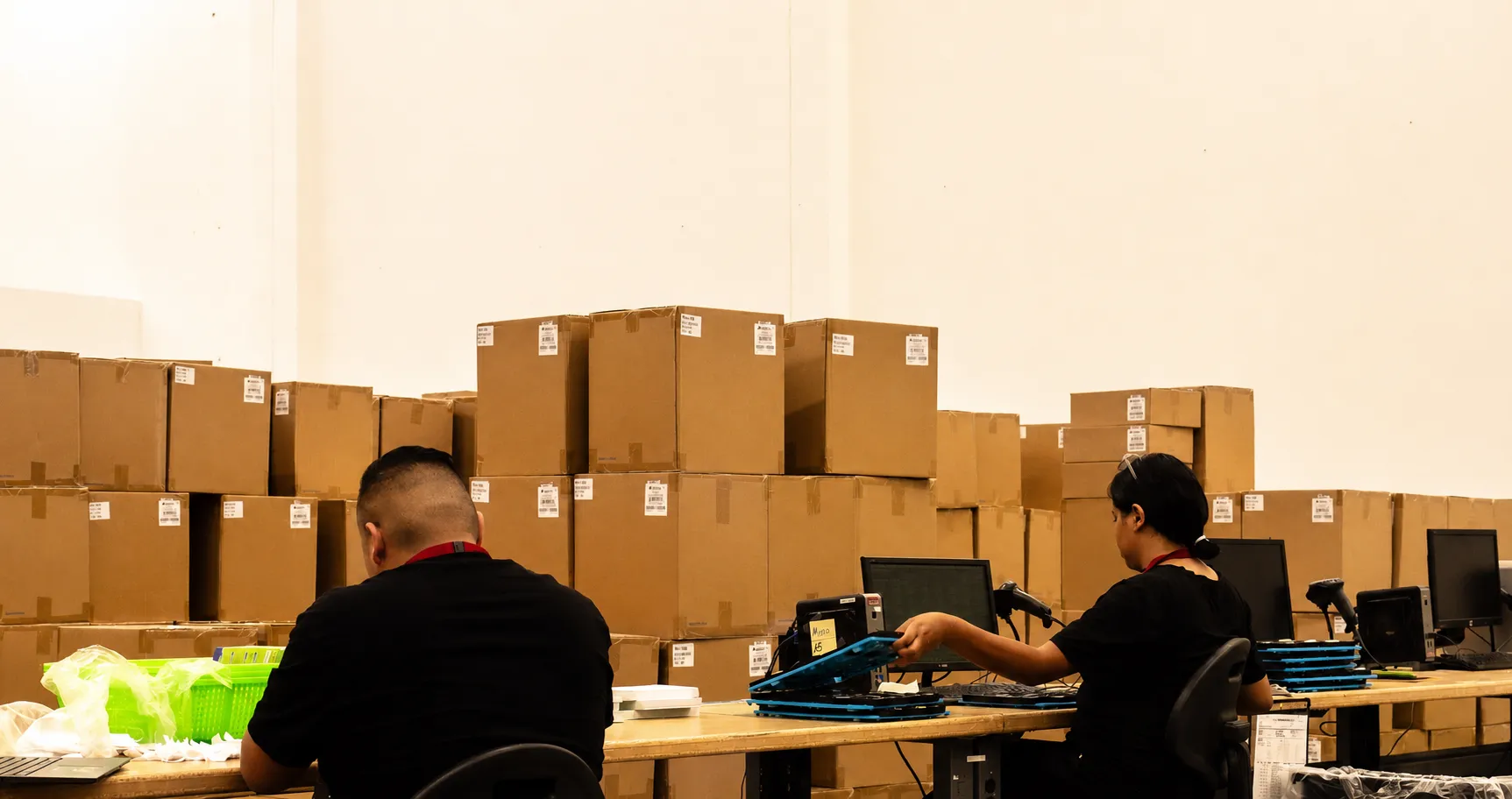
From inbound to cross-border dispatch, your inventory moves through a single connected operation — automated material handling, real-time inventory visibility and in-line inspection — all run by Lateral's team under one roof in Tijuana.
- 01Automated handling
Conveyor systems and automated material handling across the floor.
- 02Real-time visibility
Live inventory counts synced as each unit moves.
- 03In-line inspection & VAS
Quality inspection and value-added work built into the flow.
Lateral operates under IMMEX certification. The compliance infrastructure is already in place — you don't build it, you plug into it.
Which industries is contract logistics built for?
Regulated and high-value manufacturing, depending on what you make.
Medical Devices
Secure, high-security storage with product inspection and compliance-ready handling for regulated supply chains.
Explore →Aerospace
Secure, fully traceable storage with kitting and controlled handling for high-value aerospace components.
Explore →Electronics & Hi-Tech
High-value inventory, kitting and light assembly, secure storage, and the speed to serve U.S. markets from the corridor.
Explore →Automotive
Sequenced, just-in-time supply with sub-assembly and cross-border flow tuned to production lines.
Explore →Cross-border logistics in 2026 isn't a cost question. It's a compliance-risk question.
How does onboarding work?
A defined scope and service-level agreement means you know exactly what you're getting — before you commit.
- 01Discovery & assessment
Lateral maps your product flow, volumes and compliance needs.
- 02Scope & SLA definition
Fixed scope, defined service levels, transparent cost.
- 03Integration & go-live
Systems connected, first inbound received, operations live — most programs within six weeks.
Frequently asked questions
What is contract logistics?
Contract logistics is a long-term outsourcing model where one provider manages warehousing, distribution, customs coordination and value-added services for a manufacturer under a single multi-year agreement with defined service levels — replacing the fragmented, pay-per-use approach of transactional 3PL.
How is contract logistics different from a standard 3PL?
A standard 3PL is typically transactional and short-term, focused on storage and shipping. Contract logistics is a dedicated, multi-year partnership with integrated scope, predictable cost and a single point of accountability — including customs coordination and compliance.
What is IMMEX and why does it matter for cross-border logistics?
IMMEX is Mexico's export-manufacturing program that allows duty-deferred import of materials and components for goods destined for export. Operating under IMMEX-compliant infrastructure lets manufacturers reduce duty costs and manage cross-border compliance risk through their logistics partner. U.S. import duties still apply when goods enter the United States; deferral applies to the Mexican side only.
How fast can goods reach the U.S. market from Tijuana?
From the San Diego–Tijuana corridor — six miles from the Otay Mesa border crossing — goods clear into the U.S. and reach North American distribution in days, compared with the weeks of trans-Pacific lead times typical of offshore manufacturing.
What industries is contract logistics built for?
Primarily regulated and high-value manufacturing — medical devices, aerospace, electronics and hi-tech, and automotive — sectors that need secure storage, value-added services and compliance-ready handling.
Do you handle customs and returns too?
Yes. Customs documentation and clearance are coordinated cross-border, and reverse logistics — including quality inspection and product recovery — is managed under the same agreement.
How is cost structured under contract logistics?
Cost is defined by the service-level agreement: fixed scope and predictable pricing rather than variable pay-per-use, billed under one agreement instead of multiple vendor invoices. You know the cost before you commit, with a single point of accountability.
How long does it take to go live?
Most programs are live within six weeks: discovery and assessment, then scope and SLA definition, then integration and first inbound. A named contact is assigned at kickoff and integration runs in parallel with inventory transfer.
Ready to map your nearshore supply chain?
Tell us your monthly volume and product mix — Lateral maps your compliance needs and cost. No minimum, no commitment.
We reply within one business day.