3PL solutions that flex with your production
Warehousing, distribution and forward stocking billed by use — inbound materials and finished goods under one roof. Capacity scales through peaks, no fixed footprint, no minimum volume.
Does a manufacturer need its own IMMEX program to operate in Mexico?
No. Manufacturers operate under Lateral Fulfillment's IMMEX registration, with Anexo 24 inventory control maintained by Lateral — no standing up your own program, no compliance team to hire. Mexican duties are deferred until goods are sold or exported. U.S. import duties still apply when goods enter the United States; deferral applies to the Mexican side only.
One registration
Your goods move under Lateral's IMMEX — you skip the months and cost of your own program.
Anexo 24 compliance
The audited inventory-control system that keeps duty treatment defensible, maintained by Lateral.
Cash flow
Duties settle as goods sell or export — capital works in the business, not at the border.
How does flexible 3PL capacity actually work?
Storage is billed by pallet or bin actually used, and staffing scales with your volume. A launch or a seasonal peak expands the footprint; when demand settles, the bill contracts with it. Your operation follows your demand — not your lease.
- 01Receive materials
Components and finished goods received, counted and recorded under Anexo 24.
- 02Store by use
Racked or floor storage, billed by the pallet or bin you occupy.
- 03Kit & stage
Kitting, sequencing and forward stocking positioned to your demand.
- 04Cross & deliver
Daily linehaul into San Diego carrier networks.
What can a manufacturer run through the facility?
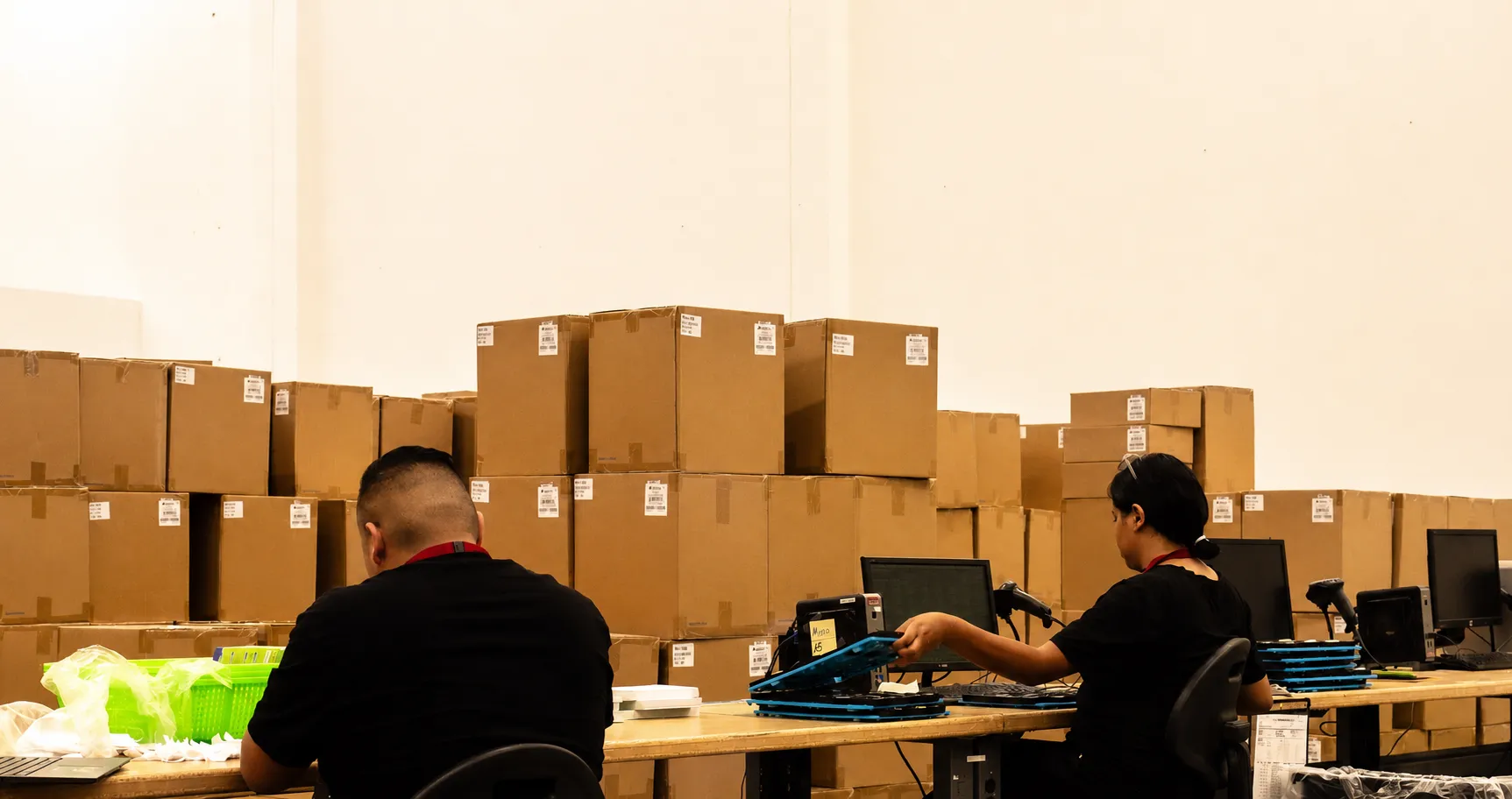
Six program types run from the same 440,000 sq ft floor, under one warehouse management system and one named contact. Programs combine freely — most manufacturers start with warehousing and distribution, then add forward stocking or kitting as volume grows.
Warehousing by use
Racked and floor storage at scale, billed by pallet or bin.
Distribution & B2B
Wholesale and retail shipments with routing-guide compliance, EDI and ASNs.
Forward stocking
Finished goods staged next to the U.S. border — shorter transit and fewer freight zones on B2B replenishment.
Inbound materials
Components received and controlled alongside finished goods.
Kitting & VAS
Kitting, sequencing and light value-added work on the same floor.
Daily cross-border
Dedicated linehaul into U.S. injection points, six miles north.
How does nearshore 3PL compare to a domestic 3PL?
| Criterion | Domestic U.S. 3PL | Lateral Fulfillment |
|---|---|---|
| Cost per order | Market rate | Up to 30% lower |
| Labor rates | U.S. market | Tijuana market |
| Storage model | Fixed commitments common | Billed by use |
| Duty treatment | Paid on arrival | Paid when your product sells |
| Account contact | Rotating team | Named, from day one |
| Cost analysis | Sales quote only | Free, on your order data |
Do you need flexible 3PL or a dedicated program?
Both run in the same building — the difference is how capacity is committed. 3PL Solutions flexes shared capacity with your demand; Contract Logistics dedicates space, staff and SLAs to one client under a multi-year agreement. Choosing right the first time saves a migration later.
| Criterion | 3PL Solutions | Contract Logistics |
|---|---|---|
| Capacity | Shared, flexes with demand | Dedicated space and staff |
| Pricing | By use — pallet, bin, order | Program under one agreement |
| Term | Rolling, no long-term lock-in | Multi-year |
| Best for | Swinging or seasonal demand | Steady, high-volume programs |
| SLAs | Standard service levels | Engineered into staffing & layout |
Lateral runs all three from the same corridor — if flexible 3PL isn't the model you need, start here:
Capacity should follow your demand — not your lease.
Is flexible 3PL the right model for your operation?
The flexible model earns its keep when demand moves. When it doesn't fit, we say so — and often the answer is a different Lateral program, not a different provider. The free cost analysis settles it with your real volumes.
✓A strong fit
- Manufacturers with seasonal peaks, launches or swinging demand
- Brands needing finished goods positioned next to the U.S. border
- Inbound components and outbound distribution under one roof
- Operations that want Mexico economics without their own IMMEX
- Retail and wholesale programs needing routing-guide compliance
—A different path
- Steady, high-volume programs with engineered SLAs → Contract Logistics
- DTC pick-and-pack as the core need → Fulfillment
- Refrigerated or frozen goods — storage is ambient only
- Footprints outside the San Diego–Tijuana corridor
Frequently asked questions
What do Lateral Fulfillment's 3PL solutions cover?
Warehousing, distribution, forward stocking, inbound materials management, kitting and daily cross-border movement — run from a 440,000 sq ft Class-A facility six miles from San Diego. Capacity flexes with demand and storage is billed by the footprint used, so the operation scales without a fixed commitment.
Does a manufacturer need its own IMMEX program to operate in Mexico?
No. Manufacturers operate under Lateral Fulfillment's IMMEX registration, with Anexo 24 inventory control maintained by Lateral. Mexican duties are deferred until goods are sold or exported. U.S. import duties still apply when goods enter the United States; deferral applies to the Mexican side only.
How does flexible 3PL capacity actually work?
Storage is billed by pallet or bin actually used, and staffing scales with volume. When a launch or seasonal peak hits, the footprint expands; when demand settles, the bill contracts with it. There is no fixed space commitment and no penalty for scaling down.
How fast can a 3PL program go live?
Most programs are live within six weeks of contract signature. Complex programs with EDI setup can take longer, but a named account contact is assigned at kickoff and integration work runs in parallel with inventory transfer, so nothing waits in sequence.
What is the difference between 3PL Solutions and Contract Logistics?
3PL Solutions uses shared, flexible capacity billed by use — built for demand that swings. Contract Logistics is dedicated space, staff and equipment under a multi-year agreement with engineered SLAs — built for steady, high-volume programs. Many manufacturers start with 3PL and graduate to a dedicated program.
Can Lateral Fulfillment handle inbound materials as well as finished goods?
Yes. Components and raw materials are received, recorded under Anexo 24 inventory control and stored alongside finished goods, so a manufacturer runs inbound supply and outbound distribution through one facility and one system instead of splitting them across vendors.
How does forward stocking reduce delivery time and cost?
Finished goods are positioned six miles from the San Diego border, so orders and B2B shipments start next to U.S. carrier networks instead of days away. Most U.S. destinations are reached in one to three days, and fewer shipping zones mean lower freight cost per shipment.
Can Lateral Fulfillment meet major retailer routing requirements?
Yes. Routing guides, EDI transactions, compliant labeling and ASNs for major retailers are handled as part of distribution programs, so shipments arrive the way each retailer requires and chargebacks are avoided.
How is 3PL warehousing priced?
By the footprint actually used — pallet or bin — plus handling on the way in and out, and any value-added work such as kitting or sequencing. Tijuana labor and warehousing rates translate to up to 30% lower cost than a comparable U.S. operation. Every engagement starts with a free cost analysis.
What visibility do manufacturers get into inventory?
Live inventory counts, order status and shipment tracking sync to your systems, with the warehouse management system as the single source of truth — updated as each unit is received, picked and shipped, and audited at 99.9% inventory accuracy.
Ready to see your numbers?
No minimum volume. No long-term lock-in. If we're not the right fit, we'll say so on the first call.
We reply within one business day.