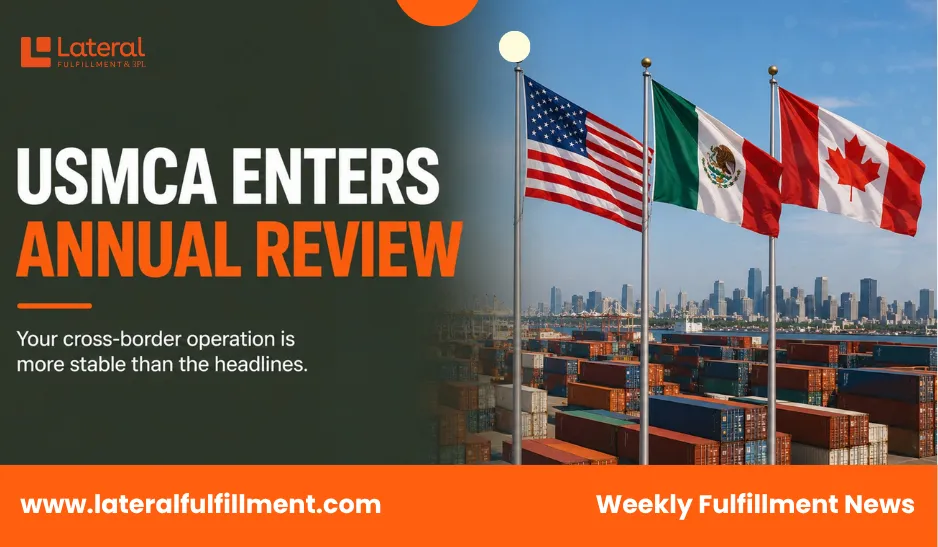
On July 1, 2026, the U.S. declined to extend USMCA. The agreement now moves into annual reviews through 2036.
For most brands, that single fact triggered a day of uncertainty. For a well-structured cross-border operation, it changed almost nothing that matters this quarter.
What did change is the structure of uncertainty going forward — and that is worth understanding clearly, because it has direct implications for how you plan inventory, manage suppliers, and structure your import strategy through 2026 and beyond.
What Actually Happened on July 1
USMCA includes a mandatory six-year joint review — a built-in mechanism for the U.S., Mexico, and Canada to assess the agreement and decide whether to extend it for 16 more years. On July 1, 2026, that review concluded without a long-term extension.
Instead of a 16-year renewal, the deal moves into a cycle of annual reviews, running each year through 2036. U.S. Trade Representative Jamieson Greer confirmed the agreement “remains in force” while the three countries continue negotiating. The next U.S.-Mexico round is already scheduled for the week of July 20.
This is not a trade collapse. It is a political negotiation cycle with a defined calendar. The distinction matters enormously for how you respond.
What Did NOT Change — The Part That Matters for USMCA Cross-Border Operations
This is the analysis you will not find in most news coverage, and it is the most operationally relevant fact: the ground under your supply chain did not move.
Tariff-free status is intact
Products that qualified for tariff-free treatment under USMCA rules of origin on June 30 still qualify today. The exemption did not expire. The mechanism did not change. If your documentation was clean yesterday, it is clean today.
Compliance is at an all-time high
USMCA compliance has climbed from 44% in 2024 to over 80% in 2026. The vast majority of cross-border shipments operating under the agreement are already shielded. The brands that invested in rules-of-origin documentation over the past two years are precisely the ones who have nothing to scramble about today.
Existing tariffs remain unchanged
Tariffs that were already in place before July 1 remain in place. Autos, industrial metals, wood products, and goods that do not meet rules-of-origin requirements continue to operate under the same tariff structure they did before the review. Nothing was added. Nothing was removed.
Not sure where your operation stands on USMCA rules-of-origin compliance? Book a 15-minute review with the Lateral team at www.lateralfulfillment.com. We’ll tell you exactly what to look at.
What Is Worth Watching — The Real Risk in Annual Reviews
The operational risk from July 1 is not what happened. It is what the annual review structure means going forward.
Annual reviews create a recurring uncertainty window. Every year through 2036, the terms of North American trade go back on the table. That makes long-range supply chain planning structurally harder — not impossible, but it requires a different approach than brands used under a 16-year certainty horizon.
Three specific areas are drawing extra scrutiny in the current negotiating round and deserve attention from any ecommerce brand or manufacturer with cross-border operations:
1. Automotive rules of origin
The percentage of content that must be produced in North America to qualify for tariff-free treatment is a central point of negotiation. Automotive suppliers and Tier 1 and Tier 2 manufacturers in Baja California and across Mexico should monitor this closely.
2. Chinese-origin content in Mexican manufacturing
One of the most actively discussed issues in the negotiations is the use of Chinese-origin components and inputs in products manufactured in Mexico. If your suppliers in Mexico use significant Chinese-sourced inputs, your rules-of-origin qualification could face additional scrutiny in future reviews.
3. Labor compliance standards
USMCA includes labor provisions that require wages and working conditions in manufacturing to meet specific standards. Compliance with these provisions is increasingly part of how tariff eligibility is assessed — not just product content.
What to Do Now: Three Moves That Protect Your USMCA Cross-Border Operations
Nothing about July 1 requires emergency action. What it does require is structured preparation for a world where trade terms get reviewed annually. Here are the three moves that matter:
1. Confirm your rules-of-origin status and tighten documentation
Your tariff exemption under USMCA is only as strong as your documentation. If a customs authority questions your rules-of-origin classification, the burden of proof is on you — and a paperwork gap can cost you the exemption even if the product legitimately qualifies.
Review your certificates of origin, supplier declarations, and content-calculation records. Make sure every SKU that relies on USMCA tariff treatment has documentation that would survive a compliance audit.
2. Map your exposure by SKU and supplier
Not every product in your catalog carries the same risk. Auto parts, products with significant Chinese-sourced components, and any goods that sit close to rules-of-origin thresholds deserve specific attention.
Build a simple exposure map: which SKUs rely on USMCA tariff treatment, which suppliers provide inputs that could draw scrutiny, and which products would face the highest duty increase if the exemption were ever suspended. That map is your planning tool for every review cycle through 2036.
3. Build annual-review flexibility into your inventory and sourcing strategy
A 16-year trade horizon allows for long-range commitments — multi-year supplier agreements, large inventory positions, fixed sourcing configurations. An annual review horizon does not.
Brands that operate with more modular sourcing, bonded warehousing for duty deferral flexibility, and IMMEX-structured operations are structurally better positioned for a world where the rules get revisited every July.
The goal is not to over-react to each review cycle. It is to build an operation that treats annual uncertainty as a checkpoint in the calendar rather than a crisis when it arrives.
Why the Nearshore Model Is the Structural Answer to Annual Trade Uncertainty
USMCA cross-border operations that run through a properly structured nearshore model have a specific advantage in this environment: IMMEX and bonded warehousing are not USMCA-dependent.
IMMEX is a Mexican federal program. Bonded warehousing operates under customs authority that exists independent of the bilateral trade agreement. Both mechanisms function as duty optimization tools regardless of where USMCA negotiations land in any given annual review.
Brands operating under IMMEX with bonded warehousing have already reduced their structural dependency on any single trade agreement. Their duty optimization is built into how they operate — not borrowed from a policy that goes back on the table every July.
That is the durable answer to recurring trade uncertainty: not predicting what negotiators will decide, but building an operation that performs regardless of what they decide.
The Bottom Line
USMCA was not renewed on July 1. It was not ended either. For a well-documented, properly structured cross-border operation, the floor is stable and the opportunity is unchanged.
The risk is not this week’s headline. The risk is building a supply chain that depends on 16-year policy certainty in a world that now operates on annual reviews. The brands that will navigate this well are the ones that structure for flexibility, document for compliance, and build on mechanisms that outlast any single negotiating round.
That is exactly what nearshore fulfillment under IMMEX and bonded warehousing is designed to deliver.
Want to understand where your operation stands on USMCA compliance and duty optimization? Book a 15-minute review with the Lateral team. We will walk you through your rules-of-origin exposure and show you how IMMEX and bonded warehousing reduce your dependency on any single trade agreement outcome.