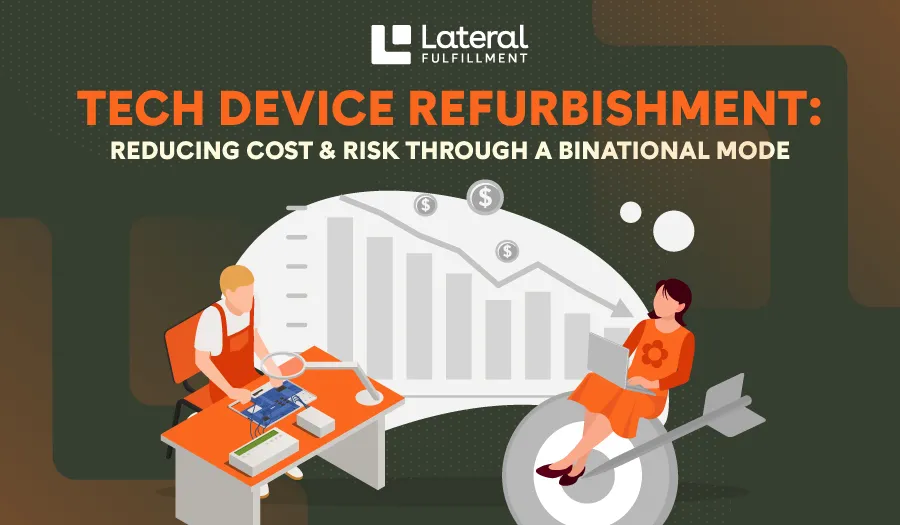
Tech refurbishment fulfillment Mexico has rapidly become one of the most critical pillars of value-added fulfillment services. As ecommerce and retail channels expand, brands face rising pressure to manage returns, warranty cycles, reconditioning, and re-commerce — all while keeping logistics cost-effective and maintaining speed.
Traditional U.S.–based refurbishment workflows are increasingly expensive, slow, and operationally rigid. This is why more brands are shifting toward a binational model that leverages Mexico’s nearshore advantages, IMMEX duty deferral, and cross-border fulfillment capabilities.
A correctly designed binational workflow reduces cost, accelerates turnaround, and minimizes operational risk — giving tech brands a smarter, more sustainable competitive edge.
Why Tech Brands Are Rethinking Their Refurbishment Strategy
Tech products present unique challenges due to:
- High return and warranty cycles
- Multiple SKUs and configurations
- Pressure for fast resale, relaunch, or re-commerce
- Shrinking margins and shorter product life cycles
- Rising labor and rework costs in the U.S.
Any delay or inefficiency in this process becomes a direct hit to profitability.
A binational refurbishment model helps stabilize cost structures while increasing operational capacity.
How a Binational Refurbishment Workflow Reduces Cost
1. Duty Deferral Through IMMEX = Lower Landed Cost
Under Mexico’s IMMEX program, brands can:
- Import tech devices into a bonded warehouse in Mexico without immediate duty payment
- Perform diagnostics, reconditioning, repairs, cleaning, or reassembly
- Re-export products to the U.S. only when sold
This effectively creates a pay-as-you-sell model, freeing up cash flow and reducing risk tied to unsold inventory.
Impact: lower landed cost, more liquidity, and greater operational flexibility.
2. Nearshore Labor & Rework Savings
Refurbishment is labor-intensive — diagnostics, component swap, QA, testing, repackaging.
Nearshoring these steps to Mexico typically results in:
- 20–40% lower labor cost
- Faster cycle times
- Greater workforce scalability
- Higher process consistency
This makes nearshore operations significantly more cost-effective than U.S.-based facilities.
3. Faster Turnaround = Lower Depreciation
Tech devices lose value rapidly.
Operating refurbishment just minutes from the U.S. border enables:
- Same-day inbound into Mexico
- Rapid refurbishment cycles
- Fast relaunch into U.S. ecommerce or retail channels
Faster turnaround reduces depreciation and protects margin.
How a Binational Model Reduces Operational Risk
1. Real-Time Visibility at Every Stage
Modern refurbishment requires full traceability:
- SKU-level and component-level tracking
- Scan-based workflow validation
- WMS and refurbishment module integration
- Workflow mapping from diagnosis → repair → QA → outbound
This enables consistent, error-free execution across all steps.
2. Multi-Carrier Routing for Rapid Re-Entry
Once refurbished, devices re-enter the U.S. via:
- Parcel
- LTL / FTL
- Cross-dock injection
A cross-border fulfillment model offers multiple routing paths, reducing dependency on any single carrier and avoiding bottlenecks.
3. Compliance and Customs Control Without Friction
Refurbishment involves complex regulatory steps:
- HS code accuracy
- Repair documentation
- Export classification
- Duty management
- Bonded warehouse requirements
With in-house U.S. & MX brokerage, compliance becomes a seamless part of the workflow — not a barrier.
Operational Improvements Tech Brands Achieve
Brands using a binational refurbishment model regularly report:
- 20–40% reduction in total refurbishment cost
- Faster turnaround cycles (days instead of weeks)
- Improved cash flow through duty deferral
- Stabilized U.S.–Mexico inventory flows
- Higher recovery value on resale
- Reduced backlog during peak seasons
- Greater control through integrated WMS visibility
This is what makes nearshore refurbishment one of the most cost-effective fulfillment solutions available.
Why Brands Choose Lateral’s Refurbishment Ecosystem
Lateral Fulfillment integrates value-added services logistics with cross-border fulfillment, offering:
- Class A infrastructure in Tijuana
- Skilled labor for diagnostics, repair, and QA
- IMMEX duty deferral + bonded warehouse Mexico
- Real-time visibility through integrated WMS
- Multi-carrier pathways for fast U.S. relaunch
- Flexible fulfillment solutions tailored to tech categories
- Cost-effective fulfillment operations at scale
It’s refurbishment designed for speed, precision, and operational efficiency — backed by a fully nearshore, cross-border fulfillment model.
Conclusion: Refurbishment Done Right Is a Competitive Advantage
Refurbishment is not just rework — it’s a strategic opportunity to:
- Recover margin
- Improve sustainability
- Reduce landed cost
- Reduce operational risk
- Accelerate resale cycles
- Protect profitability
- Enhance supply chain resilience
A binational model combining duty deferral, nearshore infrastructure, and integrated VAS workflows transforms refurbishment into a long-term profit driver.
Ready to optimize your refurbishment operation?
Let’s design a nearshore refurbishment workflow built for speed, cost control, and operational stability.